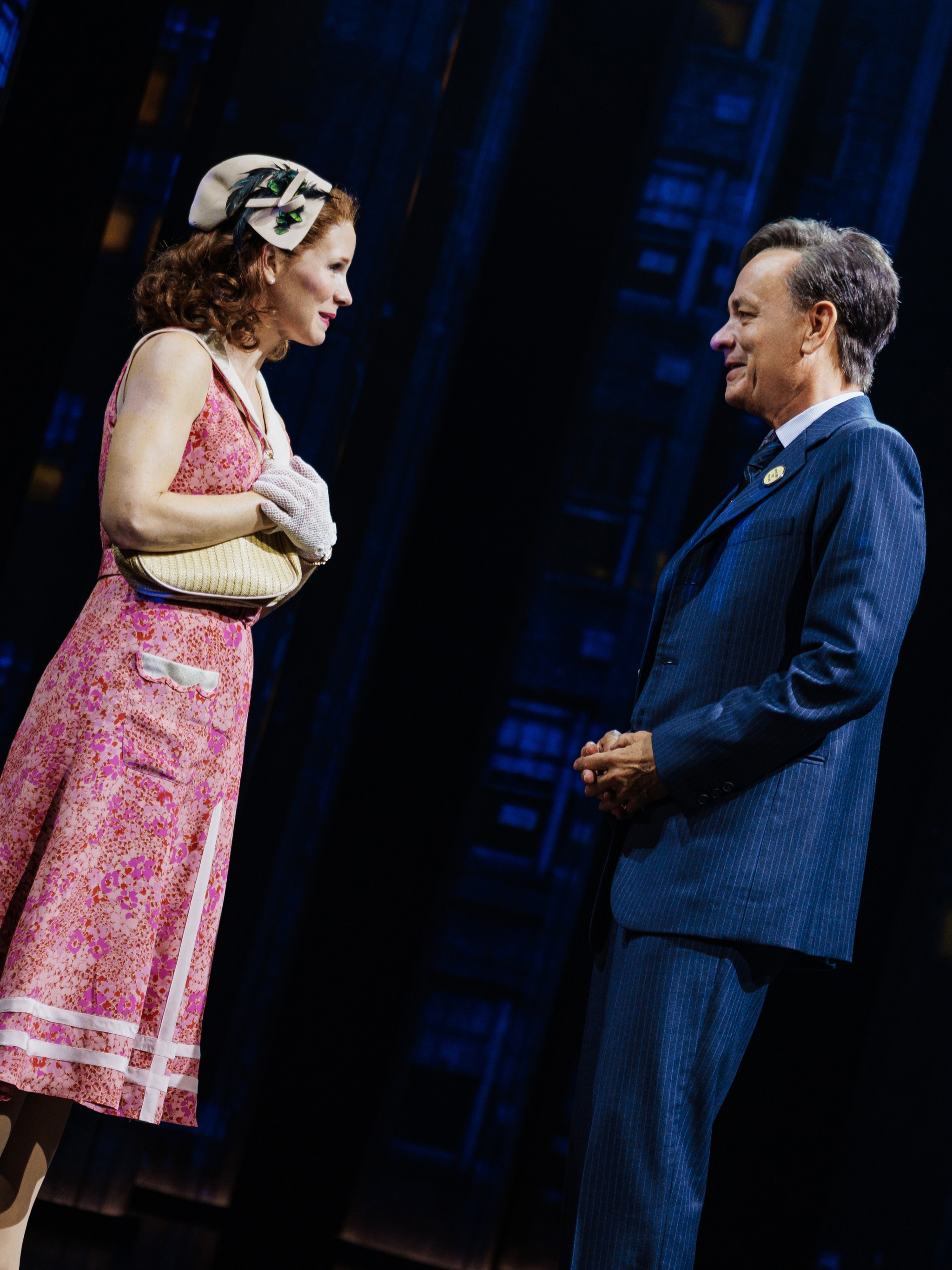

Before they came to life on the stage, Bert Allenberry, Carmen Perry, and some of the other characters who populate their past and future worlds first appeared in Uncommon Type, Tom Hanks’s 2017 collection of short stories. Three of these stories in particular captured writer James Glossman’s imagination, eventually inspiring their adaptation into three one-acts, set to be staged in early 2020. Their collaboration as playwrights in the years since has culminated in the world premiere of This World of Tomorrow at The Shed.
In September, Hanks and Glossman took a moment after the third day of rehearsals to reflect on the play’s development, the permission they’ve found working with director Kenny Leon on this production, and how love might alter your DNA.
The Shed: Would you two share how this play began? How did you become collaborators?
James Glossman: Back in Chicago, Frank Galati was a formative teacher for me. He adapted Grapes of Wrath. An idea I’ve taken from him is that one way you can investigate a non-theatrical text like a novel is to get it up on its feet, walk it around, and find ways to perform it out loud.
Even a couple of years after reading them, I couldn’t get three of Tom’s stories, “Christmas Eve 1953,” “The Past Is Important to Us,” and “Go See Costas,” out of my head, and got the idea that they would be lovely to adapt in this way as a triptych of one-acts. We were going to do it as a benefit for Shadowland Stages, a beautiful nonprofit theater upstate.
Tom Hanks: Up in the Catskills.
Glossman: We got this great cast together: David Strathairn, Jay O. Sanders, Maryann Plunkett, Sharon Washington…and then Covid happened, so it was put on ice.
Eventually we did a Zoom benefit reading of it, and a week later I got a call from Jay telling me a producer and friend of Tom’s wanted a copy of the script to pass along to him. A day later I got another phone call saying Tom Hanks wanted my phone number.
Hanks: At that point, I knew of Jay. I had seen him as Mark Antony in Julius Caesar at the American Conservatory Theatre in 1978 or ’77, ’76. And Maryann had played my wife in A Beautiful Day in the Neighborhood. I read the script of the stories you had jammed together, and I wanted to tell you, “Hey, this might be a thing.”

Glossman: Then I got a call from what absolutely sounded like the best Tom Hanks impersonator ever. He said a lot of extraordinarily kind things, and ultimately suggested that we might collaborate to create “a full play.” What sticks in my head is that Tom said, “When theaters open up again, maybe this is the kind of play that could be waiting for them, to welcome them back to the theater.” And that initial adaptation of three tales was not yet built as a play.
Hanks: I always saw “The Past Is Important to Us” as possibly having a life beyond the page. I had been keeping it in my pocket to develop a screenplay. When I read what Jim had adapted I saw how we could make time travel work with these two other, very specific stories.
Glossman: We were braiding three wildly divergent stories together into a very different piece called Safe Home, that we would eventually stage at Shadowland in 2022. But we hadn’t yet found the emotional core of the piece, which are these two people, Bert and Carmen, in This World of Tomorrow. We would speak on the phone or online, and met a few times at Tom’s agent’s offices to talk through notes.
Hanks: And when we got together, we cracked a version of the first act that had less in it, but said more because it had less.
Glossman: We wanted to strip the building down to the studs and start over with this story about Carmen and Bert and their worlds.
Then, at Portland Stage, during their Little Festival of the Unexpected in 2024, we went through three second acts over the course of a week, though none of them have much to do with where we are now. Sometimes Bert died, sometimes not. Those versions were all called See You Tomorrow.

Hanks: After that, we started passing the work back and forth, getting into some major reconstruction. We’d meet in the Chrysler building…
Glossman: …In a conference room with a view of everywhere in the world—it felt like the writers’ room on the Dick Van Dyke Show.
Hanks: In my recollection we started talking about how this play is about how people’s lives change because they decided to do one thing and not the other. They choose to go to the World’s Fair on a specific day, and their lives change. Everybody has some version of that experience.
Glossman: Bert just traveled from a little further away than Carmen did.
Hanks: Part of the fun of it was always in the laws of physics.
We had a good time working that out. We also wanted to know, in the pantheon of time-travel stories, why do you have to go back to be on board the Titanic, for crying out loud? That question drove us as playwrights.

The Shed: Jim, on the first day of rehearsals this week, you remarked that nostalgia is the enemy of this play. What did you mean by that?
Glossman: There’s a great temptation to look at the play’s setting as a time when everything was wonderful. But as Tom and Kenny have said over the past few days, this play is about finding the things that you’ve lost, not returning to a past that’s somehow perfect. We try to make it clear that 1939 wasn’t any kind of “golden age.”
Hanks: No one who has ever been alive knows that they were living in the past. People in 1910 thought they were living at the absolute cutting edge.
I think a faith in or acceptance of our foundations was paramount to the people alive in 1939. That generation had survived World War I, the Spanish Flu in 1917, there was no penicillin, no real sense of healthcare as we know it…
And yet a massive amount of societal change for the better came out of our institutions, through some combination of science, technology, curiosity, hard work, universal education, dumb luck, and complete serendipity. In 1939, there was no reason at all to assume that it wouldn’t continue along.
What the Fair communicated for the non-cynical was a dangling of possibilities. The New Yorker had some great coverage of the World’s Fair. Even cynical critics wrote that it was pretty cool. You could choose to experience what was blatantly commercial, or not. There was a pavilion for the WPA, a pavilion for Palestine, alongside the Italian pavilion okayed by Mussolini.
So the 1939 World’s Fair to me was the antidote to that other trope of time-travel stories as an adventure to Appomattox or the Titanic…

Glossman: …or to kill Hitler or save Abraham Lincoln. The 1939 World’s Fair is probably one of the high points of believing in the future, whatever “the future” means to you and however messed up the world is at this moment.
The Shed: Could we return to your experience working together in the same room. What effect did that have on your process?
Glossman: I’ve never gotten to be part of an ongoing writer’s room, but as we were working through all of this, that’s what it felt like. We were physically together, pacing around and throwing out lines, making notes and tossing things back and forth.

Hanks: I started in theater, but the only other play I’ve done in New York was Lucky Guy with George C. Wolfe. He taught me that films are about story, television is about character, and the theater is about language. And that means in theater everybody gets to land on something that advances the production.
Jim, you scan absolutely everything. I’ll read a line and you can instantly say it has three syllables too many. Take out those three syllables and it just lands.
Glossman: And then I’ll write something and you’ll say, “Okay, those two jokes, but not the third.”
We’ve never really talked about this, but we both come to writing with a sense of rhythm in language. Our work got so much deeper when we started to read out loud with each other.

Hanks: In all of this we were trying to make a cohesive piece to satisfy ourselves.
Glossman: We wanted to feel the souls of these people who were on the page.
Hanks: We wanted to elevate the characters to exist as real people.
Glossman: When The Shed first approached us about doing a reading there wasn’t yet any suggestion that Tom would act in a production. It was all about developing the script.
Hanks: And at that point a number of the characters still felt like placeholders. And, for a time, Carmen was one of them. We had yet to find her true DNA.
Glossman: What has her life cost her, and what has Bert’s cost him? We hadn’t quite gotten to those answers yet.

Hanks: I will say that we went around and around on what had happened to Carmen before the play begins. In the end, we decided she had put her faith in a coward. And when his cowardice was revealed, she was left wondering how he could have done that to her and how stupid she could have been to not see it.
Glossman: She closed herself off. In Carmen and Bert, you have two people who for different reasons can’t love, or have shut themselves off to love. How do you open up your chest again? How does love change the world?
Hanks: That was another lodestar.
Glossman: [to Hanks] I think you first came up with the thought.It was just love. What if love can literally change your DNA?
Hanks: Luckily The Shed provided us the atmosphere to explore a work in progress, with just enough pressure.
Glossman: Today after rehearsal Tom said to me, “When have I ever felt like I’ve been in a room that is this alive, where you’re this free, where minute to minute you watch the work just getting better and better?” These powerhouse actors are asking questions, making adjustments, and feeling like everybody is safe, and out there kicking it.

Hanks: Kenny has said two things. I constantly write down what he says. One was, “No one should go bigger. They should go deeper.” And then…
Glossman: …“This play is about Time and about Love,” which he said on the first day of rehearsal.
Hanks: Time and love.
Glossman: Kenny has given us permission, in a way. We’d always felt a great responsibility to make sure everything gets explained. Kenny has helped us to know we need just enough for the audience to believe. We’ve tried to follow that Occam’s razor principle, asking what do we need? Everything else should get out of the way of the actors.
Hanks: He keeps stopping us in rehearsal to say, “This is the only time the play is really ours, in rehearsal. As soon as you put it up in the theater, then it belongs to the audience.”